Understanding Commercial Solar Dryers and Their Role in Value Added Agriculture
Wiki Article
Introduction
Agricultural value addition can begin with a relatively simple processing step: drying. When suitable fruits, vegetables, spices, herbs or other farm products are converted into dried forms, the business may gain another format for handling and marketing the crop. Solar drying technology provides a way to carry out this process using solar thermal energy.
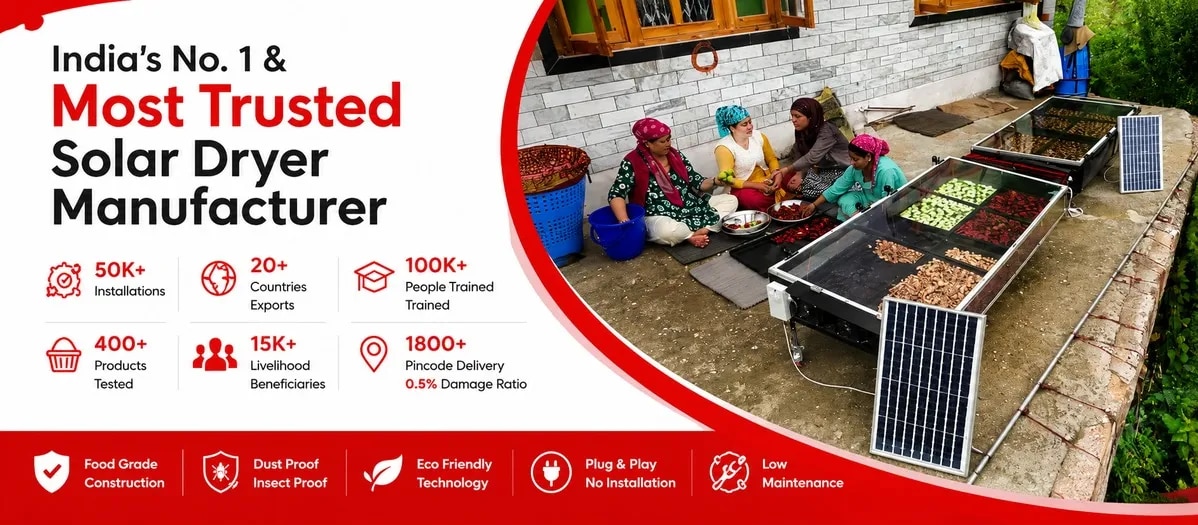
This can be relevant to farmers, FPOs, SHGs, cooperatives and food-processing businesses. Rudra Solar Energy's agricultural products dryer is designed for suitable multi-commodity farm produce and is available in configurations ranging from 5 kg per batch to 500 kg per batch.
What Is Agricultural Solar Drying?
Agricultural solar drying is the use of solar heat to remove moisture from suitable farm products. Instead of leaving produce in the open, the material is placed in a drying chamber.The process can be especially useful where solar radiation is available and where a business wants a more organised alternative to open-sun drying.
From Fresh Crop to Dried Product
The process may involve several stages:- Harvesting and selection
- Cleaning and sorting
- Preparation or cutting
- Tray loading
- Solar dehydration
- Cooling
- Packaging
- Storage
Each stage can affect the final quality of the product.
Why Farmers Look at Drying Technology
Farmers may have periods when a crop becomes available faster than it can be sold or consumed. Drying can provide another processing route for suitable products.Rudra Solar Energy states that its solar dryers are used by farmers, FPOs, SHGs and food processors and can support agricultural value addition.
Drying Is Not a Guarantee of Higher Income
A dried product may have different market opportunities, but profitability depends on actual market conditions. Raw material costs, labour, packaging, transport, processing losses, equipment costs and selling prices all matter.Therefore, businesses should develop a realistic processing and marketing plan before investing.
Products That Can Be Considered
Rudra Solar Energy lists fruits, vegetables, spices, herbs, grains, pulses, oilseeds, seeds and other agricultural products among its solar drying applications. :contentReference[oaicite:26]index=26Seasonal Flexibility
A multi-commodity dryer may be useful where different products are available in different seasons. However, each product should have its own process parameters and cleaning procedure.For example, an aromatic spice and a mild vegetable may require different handling to avoid transferring odours between batches.
Role of Enclosed Drying
Open-sun drying is exposed to outdoor conditions. Rudra Solar Energy describes its enclosed cabinet dryer as reducing direct exposure to dust, insects, birds and sudden rainfall. :contentReference[oaicite:27]index=27This can provide a more organised environment for food and agricultural processing.
Food Contact Surfaces
The product is placed on trays or other food-contact surfaces. These surfaces should be cleaned and maintained appropriately.Good hygiene remains the responsibility of the operator and processing facility.
Capacity Planning for Agricultural Groups
An FPO or Solar Dehydrator Machine cooperative may collect produce from multiple farmers, creating a larger and more regular processing requirement than an individual farm.The right capacity depends on the quantity available per batch and the frequency of processing.
Rudra's agricultural dryer range is stated to cover 5 kg per batch to 500 kg per batch.
What to Calculate Before Purchase
A group can estimate:- Fresh produce available per day
- Peak seasonal volume
- Number of processing days
- Desired batch size
- Expected product mix
- Available installation area
- Electricity availability
- Packaging capacity
These figures can help determine whether a small, medium or larger system is appropriate.
Solar Drying and Rural Entrepreneurship
Solar Solar Drying Machine drying can form part of a rural enterprise where agricultural products are processed and packaged locally. SHGs and women-led enterprises may also consider drying as one element of a broader food-processing activity.Rudra Solar Energy describes its systems as serving farmers, women entrepreneurs, SHGs, FPOs and commercial processors.
The success of such an enterprise depends on more than equipment. Product selection, quality control, packaging, branding, market access and customer demand are equally important.
Choosing the Installation Location
A solar dryer needs suitable solar exposure and enough space for operation. The location should also allow easy loading, unloading, cleaning and maintenance.Rudra Solar Energy supplies systems across India and notes that location, accessibility, product and capacity can influence system selection.
Conclusion
Agricultural Solar Dryer solar drying can help farmers and processing groups create a more structured method of dehydrating suitable crops. It can be considered for fruits, vegetables, spices, herbs, grains, pulses and other compatible agricultural materials.Rudra Solar Energy provides agricultural solar drying systems in multiple capacity configurations and positions them for farmers, FPOs, SHGs, cooperatives and commercial processors.
The technology should be evaluated as part of a complete value-addition plan. Product suitability, processing capacity, hygiene, packaging, storage and market demand all influence the outcome. With realistic planning, solar drying can become one useful component of modern agricultural processing.
 Report this wiki page